Cross-Section
Use both nominal square dimensions in the order, such as 125 × 125 mm, rather than an informal description such as “125 billet.”

A practical guide to approved square billet sizes, measurement, theoretical weight calculation, length and tolerance, applications, custom requirements and ordering.
Reviewed against the currently published Steel Billets and Technical Data size references. Final order dimensions, tolerance, length, grade and commercial weight basis remain controlled by the approved quotation and purchase specification.
Steel billet sizes affect far more than the physical dimensions of the starting stock. The billet cross-section influences reheating, rolling or forging reduction, handling, yield planning, cut-weight calculations and the suitability of the material for a specific downstream manufacturing route.
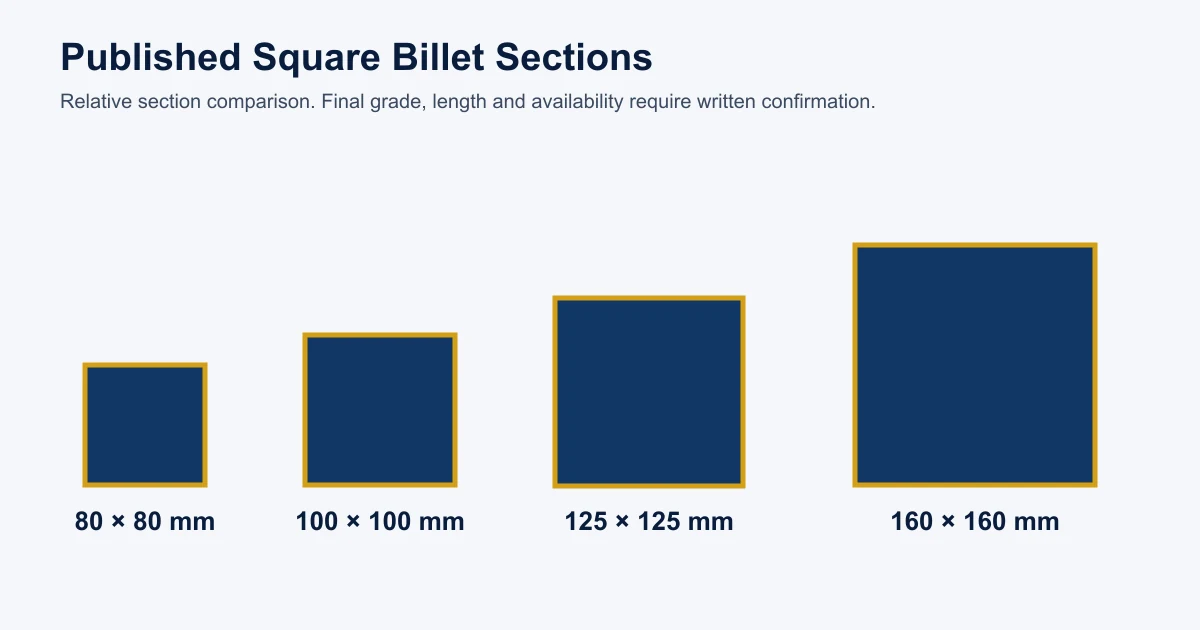
Jain Steels Group currently publishes four square Steel Billet sizes: 80 × 80 mm, 100 × 100 mm, 125 × 125 mm and 160 × 160 mm. These dimensions are also reflected in the current Technical Data size chart. Grade, length, tolerance, condition and final availability should be confirmed for each enquiry.
The current published square billet sizes are 80×80, 100×100, 125×125 and 160×160 mm. Select a billet by the complete process requirement—not by cross-section alone. The purchase specification should also define grade, standard, length, tolerance, quantity, downstream route, testing, traceability and delivery requirements.
The following dimensions are the approved size reference currently published by Jain Steels Group. They provide a starting point for buyer planning, while actual supply is confirmed according to grade, length, quantity and application.
| Billet Size | Shape | Published Weight Reference | Ordering Note |
|---|---|---|---|
| 80 × 80 mm | Square | Confirm on enquiry | Confirm grade, length, quantity, condition and downstream route. |
| 100 × 100 mm | Square | 24 kg/ft | Confirm actual order weight, length and acceptance requirements. |
| 125 × 125 mm | Square | 37.65 kg/ft | Confirm cut length and downstream rolling or forging process. |
| 160 × 160 mm | Square | 61.686 kg/ft | Confirm handling, furnace, reduction and inspection requirements. |
Note: These weight values follow the current Technical Data reference. The final commercial or billing weight basis should be stated in the quotation and purchase order.
A square steel billet is identified by the nominal dimensions of its cross-section. For example, a 100 × 100 mm billet has a nominal width and thickness of 100 mm. The complete purchase requirement should also include billet length, dimensional tolerance, end condition and any surface or straightness requirements that are relevant to the downstream process.
Use both nominal square dimensions in the order, such as 125 × 125 mm, rather than an informal description such as “125 billet.”
Define fixed cut length, an acceptable length range or another approved supply arrangement according to the rolling or forging route.
Specify the governing standard, drawing or mutually approved tolerance instead of assuming a generic dimensional limit.
Where required, define surface conditioning, cropping, identification, testing or other pre-dispatch requirements.
Theoretical billet weight can be estimated from cross-sectional area, billet length and an assumed steel density. This calculation is useful for material planning, transport estimation and comparing billet sizes, but it should not replace the commercial weight basis agreed with the supplier.
Weight (kg) = Width (m) × Thickness (m) × Length (m) × Density (kg/m³). For a planning estimate, steel density is commonly approximated at about 7,850 kg/m³. Actual density can vary slightly with steel chemistry.
A one-metre-long 100 × 100 mm billet can be estimated as: 0.10 × 0.10 × 1 × 7,850 ≈ 78.5 kg per metre. One foot of the same theoretical section is approximately 23.9 kg, which is close to the website’s published 24 kg/ft reference.
| Square Size | Approx. kg/m | Approx. kg/ft |
|---|---|---|
| 80 × 80 mm | 50.24 | 15.31 |
| 100 × 100 mm | 78.50 | 23.93 |
| 125 × 125 mm | 122.66 | 37.39 |
| 160 × 160 mm | 200.96 | 61.25 |
The values above are theoretical estimates using 7,850 kg/m³ and are provided for planning. Use the approved quotation/MTC/commercial weight basis for purchasing and billing.
The main Steel Billets page states that custom lengths are available. This is important because the same square billet section can serve very different manufacturing processes depending on whether it is supplied as longer rolling stock or as shorter cut stock for forging.
Length tolerance should be agreed separately from cross-sectional size. If material yield is sensitive, the RFQ should also clarify end cropping, cutting method, machining or scale allowance, and whether piece count or weight controls the commercial order.
State the full section, for example 160 × 160 mm.
State fixed cut length or an acceptable length range.
Reference the drawing, standard or approved customer specification.
Clarify theoretical weight, actual weight, piece count or another agreed basis.
There is no universal rule that makes a larger billet section better. The correct size should suit the mill pass design, forging reduction, heating capacity, finished geometry, handling equipment and required yield.
Square billets are reheated and reduced through rolling passes for bars, rods, sections and other long steel products.
Billets may be cut into forging stock for open-die or closed-die processing. Starting section and cut weight should be reviewed with the forging route.
Alloy and carbon-steel billets may enter forging and heat-treatment routes for shafts, gears and other engineered components.
Billets can be converted into intermediate and finished products used in machinery and heavy-engineering applications.
Jain Steels Group currently publishes 80×80, 100×100, 125×125 and 160×160 mm as the standard website reference. If your requirement falls outside these dimensions, submit it as a custom size requirement and wait for technical and commercial confirmation before treating it as available.
For a custom enquiry, provide the grade, square section, length, quantity, downstream process, inspection requirements, schedule and destination. This gives the production and quality teams enough information to evaluate feasibility.
Specify 80×80, 100×100, 125×125, 160×160 mm or clearly identify a custom requirement.
State mild, carbon or alloy steel grade and the controlling specification.
Share the required cut length or acceptable length range and tolerances.
State tonnes, number of pieces or both where required.
Identify rolling, forging, rerolling or another conversion route.
Define chemistry, mechanical, ultrasonic or customer-specific inspection requirements.
State MTC, heat identification and third-party inspection requirements where applicable.
Provide destination, required schedule and any dispatch conditions.
The current square sizes are 80×80, 100×100, 125×125 and 160×160 mm. Grade, length, quantity, condition and final availability are confirmed per enquiry.
Theoretical weight is estimated from cross-sectional area × length × assumed steel density. Use the supplier’s approved commercial weight basis for ordering and billing.
Yes. The Steel Billets product page currently identifies custom length availability. Share the required length and tolerance with the grade, square size and quantity.
Yes, as a custom requirement. Availability should not be assumed until technical and commercial feasibility has been confirmed.
Continue to current product specifications, published size references and enquiry information.
Continue with the product, quality and buyer guidance relevant to this page.