

Direct answer
Steel Billet, Bloom and Slab: A Practical Buyer Comparison is best treated as a specification and process-control question, not as a keyword variation. A useful decision starts with the intended component or conversion route and then records the exact material, dimensions, condition, inspection evidence and delivery scope. For the focus topic “steel billet vs bloom vs slab”, buyers should ask for written confirmation rather than relying on a grade name or product label by itself.
This guide is written for purchase teams and engineers comparing semi-finished steel. It separates the information needed for an enquiry from the evidence needed for acceptance, helping commercial and technical teams evaluate the same requirement without adding unnecessary keyword repetition.
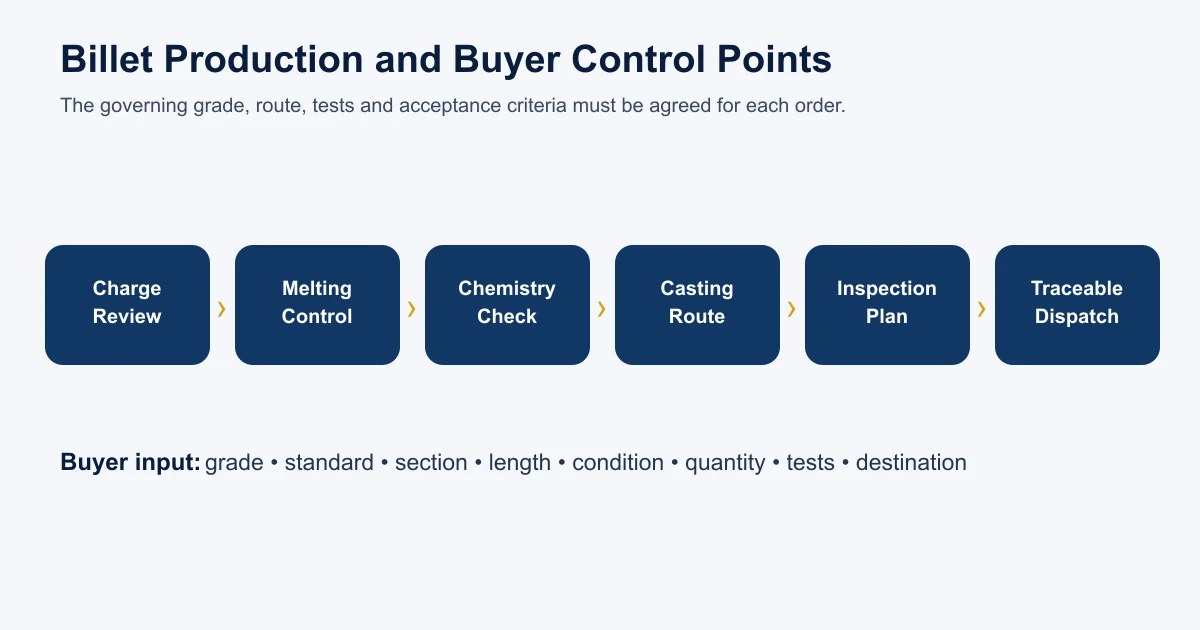
Decision points to record
| Decision point | What to confirm | Where to record it |
|---|---|---|
| terminology | State the exact requirement and controlling document. | RFQ and quotation |
| downstream route | Explain how it affects processing or acceptance. | RFQ and quotation |
| section and length | Define the measurable value, method or permitted range. | Quality plan and MTC |
| traceability | Record who verifies it and which certificate carries the result. | Quality plan and MTC |
| acceptance criteria | Resolve exceptions before purchase-order acceptance. | Purchase order and dispatch record |
Start with the intended use
The same steel description can lead to different purchasing requirements when the downstream route changes. Forging, rerolling, machining, heat treatment and project supply place different emphasis on section, tolerance, surface condition, internal soundness and certification. State the intended use early so the supplier can identify missing inputs before quoting.
Where a drawing, customer standard and purchase specification overlap, establish which document governs and how conflicts will be resolved. Any proposed substitution should be written, technically reviewed and approved before production or dispatch.
Build a measurable specification
Translate general wording into measurable requirements. Record the grade and standard edition, dimensions and permitted variation, supply condition, quantity, sampling plan, test method, acceptance criteria, marking, material test certificate scope and delivery destination. Avoid copying limits from an unrelated application.
For Jain Steels Group’s published range, round bars are generally referenced from 25 mm to 66 mm diameter, while square billet sections are published at 80 × 80, 100 × 100, 125 × 125 and 160 × 160 mm. Every grade-size combination, length, condition, test scope and quantity still requires confirmation.
Evidence to request before acceptance
Agree how material will be identified from heat to dispatch bundle and which records accompany the shipment. Depending on the accepted order, evidence may include chemistry results, dimensional inspection, mechanical testing, additional quality checks and a material test certificate. Inspection requirements should name the test method and acceptance level instead of using open-ended terms such as “premium quality”.
Receiving teams should compare markings, quantities, dimensions and documents with the purchase order before releasing material to production. If a deviation is found, preserve traceability, photographs, measurement records and the affected heat or bundle identity.
Questions for the supplier
- Which exact grade and governing standard will appear on the quotation and certificate?
- Which product dimensions, tolerances and supply condition can be confirmed for this order?
- Which inspection and test results will be reported, and at what sampling frequency?
- How will heat or batch identity remain traceable through marking, packing and dispatch?
- Which technical or commercial exclusions must be resolved before purchase-order acceptance?
- Who approves a change in material, size, route, testing or delivery scope?
Internal resources
Send a complete enquiry
Use the contact page to share grade, standard, dimensions, condition, quantity, application, testing, certificate requirements and destination. Jain Steels Group can then confirm the feasible scope in writing.