1. State the downstream use
Explain whether the material is for forging, machining, shafts, gears, fabrication or another documented process.

Technical buyer guide
Use this practical guide to understand published diameters, estimate planning weight and prepare a clearer round bar enquiry.
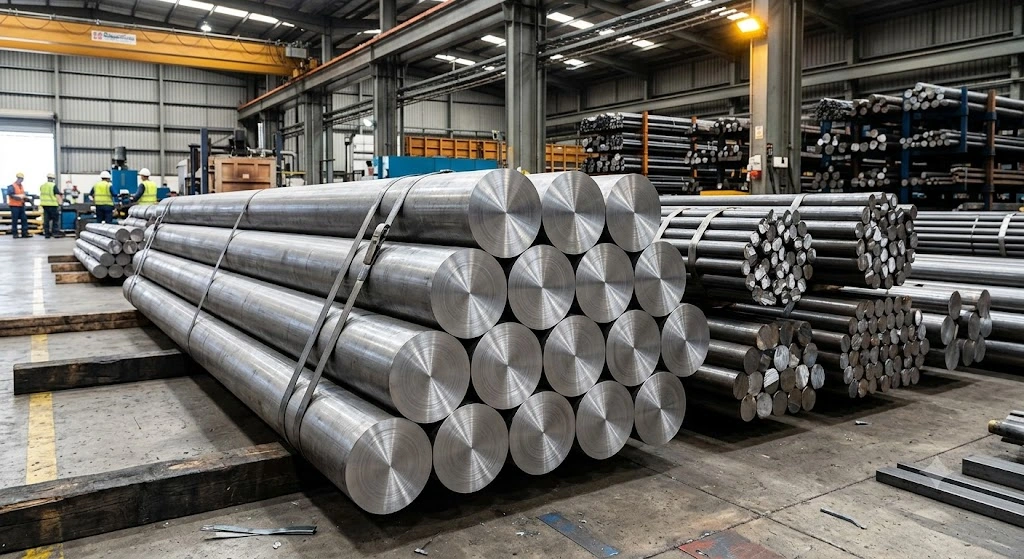
A steel round bar is a solid bar with a circular cross-section. Buyers usually specify diameter, grade or governing standard, supply condition, length, quantity, application and documentation requirements. The right selection depends on the final operation—such as forging, machining or fabrication—not on the generic name alone.
Jain Steels Group publishes a round-bar diameter reference of 25 mm to 66 mm. The published range helps a buyer begin an enquiry, but it does not confirm that every grade, length, tolerance or supply condition is available in every diameter. Those details need written confirmation before an order is accepted.
| Published diameter reference | What the buyer should confirm |
|---|---|
| 25 mm to 66 mm | Exact diameter, applicable tolerance, grade and supply condition |
| Length requirement | Cut length, fixed length or other approved requirement |
| Weight estimate | Calculation basis and whether actual delivery weight governs the order |
| Documentation | Material test certificate, heat identification and inspection requirements |
Do not use a public size chart as a substitute for a controlled purchase specification. In particular, weight can vary with diameter tolerance, actual density, length and the method used for measurement.
Use this as a planning estimate only. Enter the diameter and length. The default density is 7,850 kg/m³, commonly used for a preliminary steel estimate; the final product grade, density, tolerance and actual weight must be confirmed against the order.
Estimated weight: 3.85 kg
The basic calculation uses the circular cross-sectional area, length and a density value. In simple terms: weight = π × diameter² ÷ 4 × length × density, with units converted consistently. This is useful for transport planning and preliminary quantity review, but an estimate should not override actual weighment, the approved standard or commercial terms.
Explain whether the material is for forging, machining, shafts, gears, fabrication or another documented process.
Give the grade, governing standard, condition and any required test or certificate before requesting a quotation.
Include diameter, length, quantity, tolerance where applicable and destination or collection plan.
The website publishes a diameter reference of 25 mm to 66 mm. Confirm actual grade-size-condition availability for the individual enquiry.
No. Use it as an estimate only. The order should define the agreed measurement, tolerance and commercial basis.
Include grade or standard, diameter, condition, length, quantity, intended use, documentation requirement and delivery location.
Send grade, diameter, length, quantity, documents and destination so the requirement can be reviewed accurately.
Send an RFQ